How to Choose a Stop Start Battery in 2026
Choosing a stop start battery in 2026 takes more than comparing prices. The right choice depends on your vehicle’s exact requirements, driving pattern, and electrical equipment. Start with the owner’s manual or the vehicle maker’s parts information. Check the battery technology, case dimensions, terminal layout, capacity, and cold-cranking rating. Small mismatches matter. A battery can fit the tray yet still be unsuitable for the charging system.
Many stop-start vehicles require an AGM or EFB battery, but these types are not interchangeable in every application. Follow the specification listed for your model, and ask a qualified technician if the information is unclear. Also check whether your vehicle needs battery registration or an energy-management reset after replacement; procedures vary by make and year. That detail is easy to miss. Consider your daily use, too: frequent short trips, long periods parked, and heavy accessory loads can affect battery life. A higher advertised capacity does not automatically mean a better fit.
This guide explains how to compare compatible options, read key ratings, assess warranty terms, and avoid common buying mistakes. It focuses on verifiable specifications rather than brand promises. I would still confirm fitment using the vehicle identification number or a trusted parts catalogue, because catalogue data can be imperfect. That is worth admitting. The goal is dependable starting, not the biggest number on a label.
Understand How Stop-Start Batteries Differ from Standard Car Batteries
A standard car battery is built mainly to deliver a strong burst of power when the engine starts. A stop-start vehicle asks more of its battery. It may shut down at a traffic light, then restart when the driver lifts a foot from the brake. Repeated cycles place extra demands on charge recovery and durability. Small differences matter.
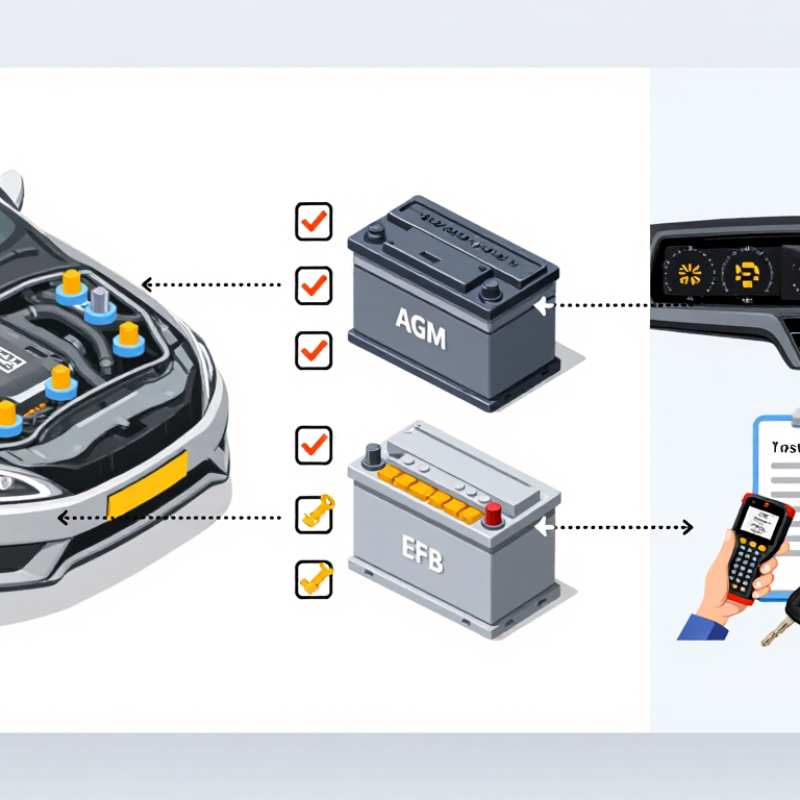
Many stop-start vehicles use an enhanced flooded battery (EFB) or an absorbed glass mat battery (AGM). These designs tolerate repeated cycling better than a conventional flooded battery. They are not interchangeable by default. Check the vehicle manual or the battery label for the required type, size, capacity, and cold-cranking rating. A cheaper standard battery may fit the tray, yet wear out sooner. Fit is not the same as compatibility.
Look closely at the vehicle’s requirements before choosing a replacement. Some cars also need the battery-management system to be reset or updated after installation; confirm this in the service information. That step is easy to miss. A battery’s label alone cannot tell you whether it suits your driving pattern, either. Frequent short trips may leave less time for charging, even with the correct type. It is a detail worth checking, not guessing.
How to Choose a Stop Start Battery in 2026 - Understand How Stop-Start Batteries Differ from Standard Car Batteries
| Battery type |
Typical construction |
Stop-start suitability |
Typical capacity and CCA* |
What to consider when choosing |
| Standard flooded |
Liquid electrolyte; conventional lead-acid design. |
Generally intended for vehicles without automatic stop-start. Not a suitable upgrade or substitute where the vehicle specifies EFB or AGM. |
About 40–80 Ah; roughly 300–800 CCA. |
Choose only if the vehicle manufacturer specifies a standard flooded battery and the size and ratings match. |
| Enhanced flooded (EFB) |
Improved flooded lead-acid design, built to handle more charge and discharge cycles than a conventional flooded battery. |
Commonly specified for entry-level stop-start systems and vehicles with moderate electrical demand. |
About 50–100 Ah; roughly 450–900 CCA. |
Use EFB when specified. An EFB-to-AGM change should be made only if the vehicle manufacturer permits it and the charging system is compatible. |
| Absorbent glass mat (AGM) |
Valve-regulated lead-acid battery with electrolyte held in glass-fibre separators; sealed and spill-resistant in normal use. |
Often specified for advanced stop-start systems, regenerative braking, or vehicles with high electrical loads. |
About 50–100 Ah; roughly 500–1,000 CCA. |
If the vehicle came with AGM, replace it with AGM unless the manufacturer explicitly approves another type. Confirm charging-system and battery-monitoring requirements. |
*Capacity and cold-cranking amp (CCA) figures are broad examples, not fitment specifications. Actual values vary by battery size, test standard, and vehicle. Before buying, match the owner’s-manual specification, case dimensions, terminal layout, polarity, capacity, CCA, and venting requirements. Some vehicles also require battery registration or battery-management-system configuration after replacement.
Check Your Vehicle’s Battery Specifications and Compatibility
A stop-start battery must match your vehicle, not just fit beneath the hood. Check the owner’s manual or battery label for the required technology, such as AGM or EFB. These types are built to handle frequent engine restarts and repeated charging cycles. A standard battery may fit physically yet fail sooner in a stop-start system.
Tips: Measure the battery tray and check terminal positions before buying. Confirm the battery’s group size, capacity, and cold-cranking rating against your vehicle’s specifications. Higher numbers are not automatically better. Some vehicles also require battery registration or a system reset after replacement, so check the service instructions.
Compatibility details can be easy to overlook. A reversed terminal layout may leave cables too short, while a slightly different case height can prevent the hold-down from securing the battery. If the manual is unclear, compare the existing battery’s label with the vehicle’s specifications, then verify with a qualified technician. I would not rely on appearance alone; it is an easy mistake, and one I’d want to double-check.
Compare AGM and EFB Battery Types for Your Driving Needs
Stop-start driving places repeated demands on a battery, especially in traffic with frequent engine restarts. AGM and EFB batteries are both designed for this work, but they suit different vehicle systems.
The correct choice is usually the type specified for your car, not simply the one with the higher price.
EFB batteries are commonly used in vehicles with basic stop-start systems and moderate electrical demands. They handle repeated cycling better than conventional flooded batteries. AGM batteries typically support greater cycling loads and can suit vehicles with more demanding electrical equipment or energy-recovery systems. Check the owner’s manual and the label on the installed battery before buying. Look closely.
An AGM battery should not usually be replaced with an EFB unless the vehicle maker permits it. The reverse change may also be unsuitable, and some vehicles need battery-system registration after replacement. I used to think matching the size and terminals was enough; it isn’t. A battery can fit under the hood and still be wrong for the charging system. Consider your daily pattern, too: short trips and long traffic waits leave less time for recharging. Cold starts matter. If the specification is unclear, ask a qualified technician to verify the battery type and required settings.
Evaluate Capacity, Cold-Cranking Amps, and Battery Lifespan
For a stop-start car, match the battery technology and capacity specified in its manual. A larger amp-hour figure is not automatically better; the battery must fit the charging system and tray. Check both amp-hour capacity and reserve capacity, which indicates how long a fully charged battery can supply a standard load. That reserve matters when traffic is slow and the engine restarts repeatedly. Numbers can mislead. SAE J537 defines cold-cranking amps through a test at 0°F (-18°C): a 12-volt battery must deliver its rated current for 30 seconds while staying at or above 7.2 volts. In practical terms, CCA helps compare cold-start performance, but it does not measure every aspect of stop-start suitability.
Battery age deserves equal attention. AAA’s automotive battery guidance gives a typical service life of about three to five years, though heat, frequent short trips, and deep discharges can shorten it. A battery may look clean and still struggle on a frosty morning. Check its date code, inspect for swelling or corrosion, and have its state of health tested rather than relying only on a dashboard warning. There is no perfect lifespan estimate for every driver; that uncertainty is easy to ignore when a battery seems fine. Choose a replacement that meets the vehicle’s specified capacity and CCA, then keep the receipt and installation date for later checks.
How to Choose a Stop-Start Battery in 2026
Illustrative ratings for common 12-volt battery types. Actual capacity and cold-cranking amps (CCA) vary by battery size and model.
How to read it: Capacity is shown in amp-hours (Ah); CCA measures starting current in cold conditions. Typical service life is roughly 3–5 years for conventional flooded, 4–6 years for EFB, and 4–7 years for AGM batteries, but climate and driving patterns matter. These are broad estimates, not guarantees. Match the vehicle maker’s required battery type, capacity, and minimum CCA; do not assume a higher rating is automatically compatible.
Confirm Installation, Battery Registration, and Warranty Requirements
Before buying a stop-start battery, check the vehicle handbook and the battery currently installed. Note its technology, size, terminal layout, and capacity. A battery that fits the tray may still be unsuitable for frequent engine restarts. Ask a qualified installer to confirm compatibility, especially if the car has energy management or a battery sensor. The small details matter.
Confirm whether installation includes battery registration or coding. Some vehicles need their charging system updated after a replacement; otherwise, charging behavior may not match the new battery. Ask what the procedure involves and whether the installer can provide a record. Keep the invoice and any diagnostic report. I used to think a correct fit was enough. It isn’t always.
Read the warranty terms before paying. Check its length, what counts as a covered fault, and whether installation by an approved professional is required. Ask how a claim is assessed and what proof you should keep. A vague verbal promise is hard to rely on later. Get the key conditions in writing, and make sure the warranty starts on the installation date, not an unclear earlier date. If the answers differ between the seller and installer, pause and verify them. That extra conversation can prevent an avoidable dispute.