10 Essential Tips for Choosing a Heavy Duty Car Battery

Choosing the right heavy duty car battery is crucial for your vehicle's performance. This task can be challenging for many. It's not just about picking any battery; it’s about finding the one that suits your needs best.

A heavy duty car battery provides significant power. It supports larger engines and heavy vehicles. However, many consumers overlook details in their selection. They often focus solely on price and brand. This can lead to mistakes that affect performance. A battery that’s too weak will struggle, leaving you stranded. Understanding specifications matters.

When selecting a heavy duty car battery, consider your vehicle's requirements. Look at the climate where you live. Cold weather impacts battery performance. Think about how you use your vehicle. Frequent short trips require more reliable power. Don't rush the process. Take your time to research and reflect on your choices. This ensures you choose wisely.
10 Essential Tips for Choosing a Heavy Duty Car Battery

Understanding Heavy Duty Car Batteries: Key Characteristics and Types

10 Essential Tips for Choosing a Heavy Duty Car Battery

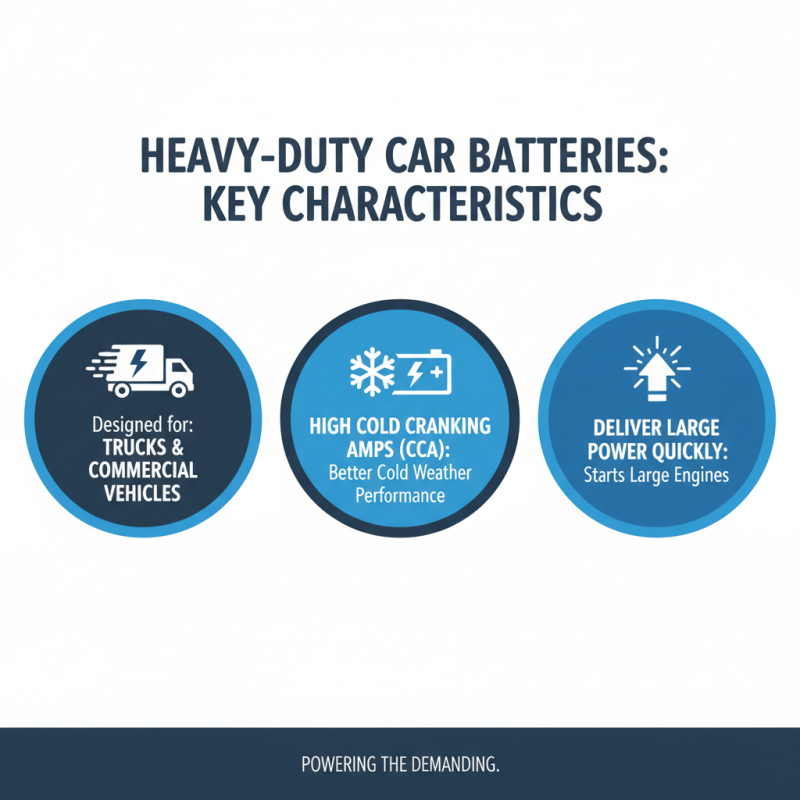
When it comes to heavy-duty car batteries, understanding their key characteristics is vital. These batteries are designed to provide high power for demanding vehicles, such as trucks and commercial vehicles. They often have a higher cold cranking amp (CCA) rating, which means they perform better in cold weather. A typical heavy-duty battery can deliver a large amount of power quickly. This is necessary for starting large engines.

In addition to CCA, heavy-duty batteries feature durability. They are built to withstand harsh conditions, such as extreme temperatures and vibration. For example, if a truck is used off-road, the battery must handle bumps and jolts. This can lead to battery damage over time, so choosing a robust option is essential. AGM (Absorbed Glass Mat) batteries are one type that excels in these conditions. They are sealed and spill-proof, making them safer for high-demand environments.

Considering types, there are standard lead-acid batteries and more advanced options like lithium-ion batteries. Lead-acid batteries are often heavier and less expensive, but lithium models are lighter and last longer. It's important to reflect on your specific needs before making a choice. Will you mainly drive in the city, or do you need something for harsh terrains? Knowing your vehicle's requirements can help in making the right decision.
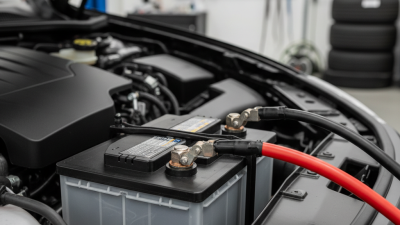
Evaluating Battery Capacity: Choosing the Right Amp-Hour Rating

When selecting a heavy-duty car battery, evaluating the amp-hour (Ah) rating is critical. This rating measures how much current a battery can supply over a set period. For instance, a battery rated at 100 Ah can theoretically deliver 5 amps for 20 hours. This means it supports various electrical needs, especially for heavy-duty applications.

Understanding your vehicle's requirements helps in making the right choice. A typical truck might require a battery with at least 70-100 Ah to operate efficiently. According to industry reports, many heavy-duty vehicles use batteries that exceed 120 Ah for optimal performance. However, while more power seems better, a higher Ah rating can lead to increased weight and cost. Balancing these factors is essential.

Moreover, usage patterns impact battery selection. Frequent short trips might necessitate a higher Ah rating to avoid frequent discharges. In contrast, prolonged driving may require less power. Some drivers overlook this. They choose batteries based solely on price or brand reputation, potentially leading to performance issues. Evaluating these specific needs is vital for ensuring reliability.

Cold Cranking Amps (CCA) Explained: Importance for Heavy Duty Applications

10 Essential Tips for Choosing a Heavy Duty Car Battery

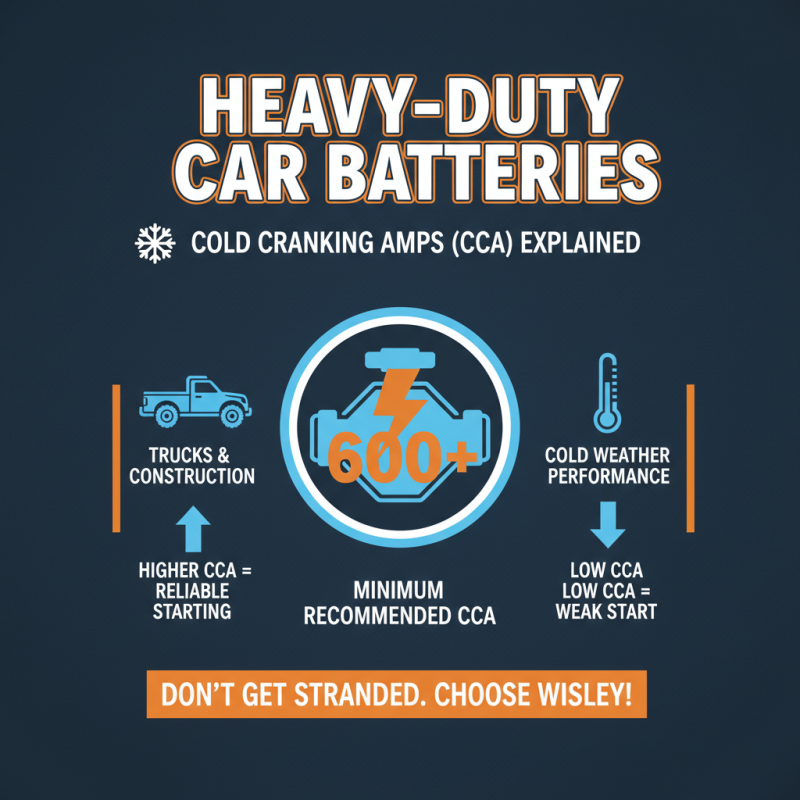
When selecting a heavy-duty car battery, understanding Cold Cranking Amps (CCA) is crucial. CCA indicates a battery's ability to start an engine in cold conditions. Higher CCA ratings ensure reliable starting power, especially in heavy-duty applications like trucks or construction equipment. Industry data shows that a minimum of 600 CCA is recommended for most heavy-duty vehicles. While some may think they can get by with lower ratings, cold weather can quickly expose battery weaknesses.

Tip: Always check the weather conditions in your area. If you live in a place with harsh winters, opt for a battery with even higher CCA. This will help avoid the frustrating experience of a dead battery when you need your vehicle the most.

Another key factor is the battery's reserve capacity (RC). RC measures how long a battery can run without the engine. For heavy-duty vehicles, a reserve capacity of at least 120 minutes is optimal. This ensures that in case of alternator failure, your vehicle can still function. Many overlook this aspect, assuming that higher CCA makes up for shorter RC, but both metrics are essential.

Tip: Look for batteries that meet both CCA and RC specifications. Balancing these two will ensure your vehicle performs reliably under all conditions. Remember, investing in the right battery capacity is investing in your vehicle's longevity.

Comparing Warranty Lengths: A Factor in Battery Durability and Reliability

When selecting a heavy-duty car battery, warranty length plays a crucial role in determining durability and reliability. A recent report by the Battery Council International states that batteries with longer warranties often last longer in real-world scenarios. On average, a battery with a 5-year warranty can outperform one with a mere 1-year warranty by as much as 30% in lifespan.

Consumers frequently overlook this aspect. Many focus solely on price rather than the warranty. A short warranty may imply lesser quality, leading to potential disappointment down the line. A study by J.D. Power reveals that 28% of customers experienced battery failure within the first year, primarily due to inadequate warranties. This gap signifies a need for careful consideration when choosing a battery.

Physical factors also influence performance. Temperature variations can impact battery life, affecting warranty accountability. Interestingly, not all warranties cover extreme temperatures. It's important to read the fine print and understand what the warranty entails. Some may offer a “free replacement” period, which sounds appealing. However, the replacement may not address the root cause of battery failure, leaving consumers back at square one.

Identifying Quality Brands: Top Manufacturers for Heavy Duty Batteries

When looking for a heavy-duty car battery, knowing the brands that consistently deliver quality is crucial. Many manufacturers focus on durability and performance. Research shows that these brands pay attention to materials and technology. High-quality batteries often have a longer lifespan and better resistance to extreme conditions.

Explore the features that define reliable brands. Look for warranties that signal confidence in their products. Warranty periods can vary, so take note. Customer reviews also provide insight into performance and longevity. Some brands offer helpful customer support, enhancing the overall experience.

It's important to recognize that not all products meet expectations. Some batteries might underperform after a short period. Understanding common issues reported can help you avoid bad choices. Reflecting on what you need in a battery will lead you to better options. Emphasizing quality over cost is often a wise investment. This will save you time and money in the long run.

10 Essential Tips for Choosing a Heavy Duty Car Battery

Feature Description Importance
Cold Cranking Amps (CCA) Measures the battery's ability to start an engine in cold temperatures. High CCA is crucial for reliable starts in winter conditions.
Reserve Capacity (RC) Indicates how long the battery can run on its own power without the engine. Higher RC gives more time for the driver to start the vehicle in emergencies.
Battery Type Different types include Lead-Acid, AGM, and Lithium-Ion. Choosing the right type enhances performance and lifespan.
Size and Fit Ensure the battery dimensions fit your vehicle model. Incorrect sizes can lead to installation issues.
Brand Reputation Consider brands known for quality and reliability. A strong reputation often reflects better product quality.
Warranty Look for batteries that offer longer warranties. Longer warranties indicate confidence in performance and longevity.
Maintenance Requirements Some batteries require regular maintenance, while others are maintenance-free. Maintenance-free options are typically more user-friendly.
Price Consider the overall cost in relation to performance and features. Higher price does not always guarantee better quality; compare values.
Discharge Rate The rate at which a battery loses power when not in use. Lower discharge rates extend usable life, especially for infrequent users.
Environmental Considerations Some batteries are more environmentally friendly than others. Eco-friendly options contribute to sustainability efforts.